

If property taxes have felt confusing lately, you're not alone. Montana changed how homes are taxed starting in 2026, and there's a refund opening up in January for people who should have gotten the lower rate but didn't.
I'm not a tax expert, and this isn't tax advice. Here's a plain-language rundown of what the Montana Department of Revenue has shared, with links so you can read it straight from the source.
Key dates at a glance
November 30, 2026: first-half 2026 property taxes due
January 1, 2027: refund requests open
March 1, 2027: deadline to enroll for the 2027 lower rate
May 31, 2027: refund deadline and second-half taxes due
Does my Montana home get the lower 2026 tax rate?
Starting in 2026, Montana taxes the home you actually live in at a lower rate than second homes, vacation cabins and short-term rentals. Long-term rentals get the lower rate too. The idea, according to the state, is to support long-term housing for people who live and work here.
Your home gets the lower rate automatically if:
You received the 2025 property tax rebate, and
You still own the home and live there at least 7 months of 2026
Long-term rentals (rented 28 days or more at a time, for at least 7 months of the year) also qualify, but the owner has to apply. The deadline to enroll for 2027 is March 1, 2027.
The lower rate covers single-family homes, townhomes, condos, manufactured and mobile homes (with up to 1 acre of land), and homes on agricultural or forest land.
How do Montana's 2026 property tax rates work?
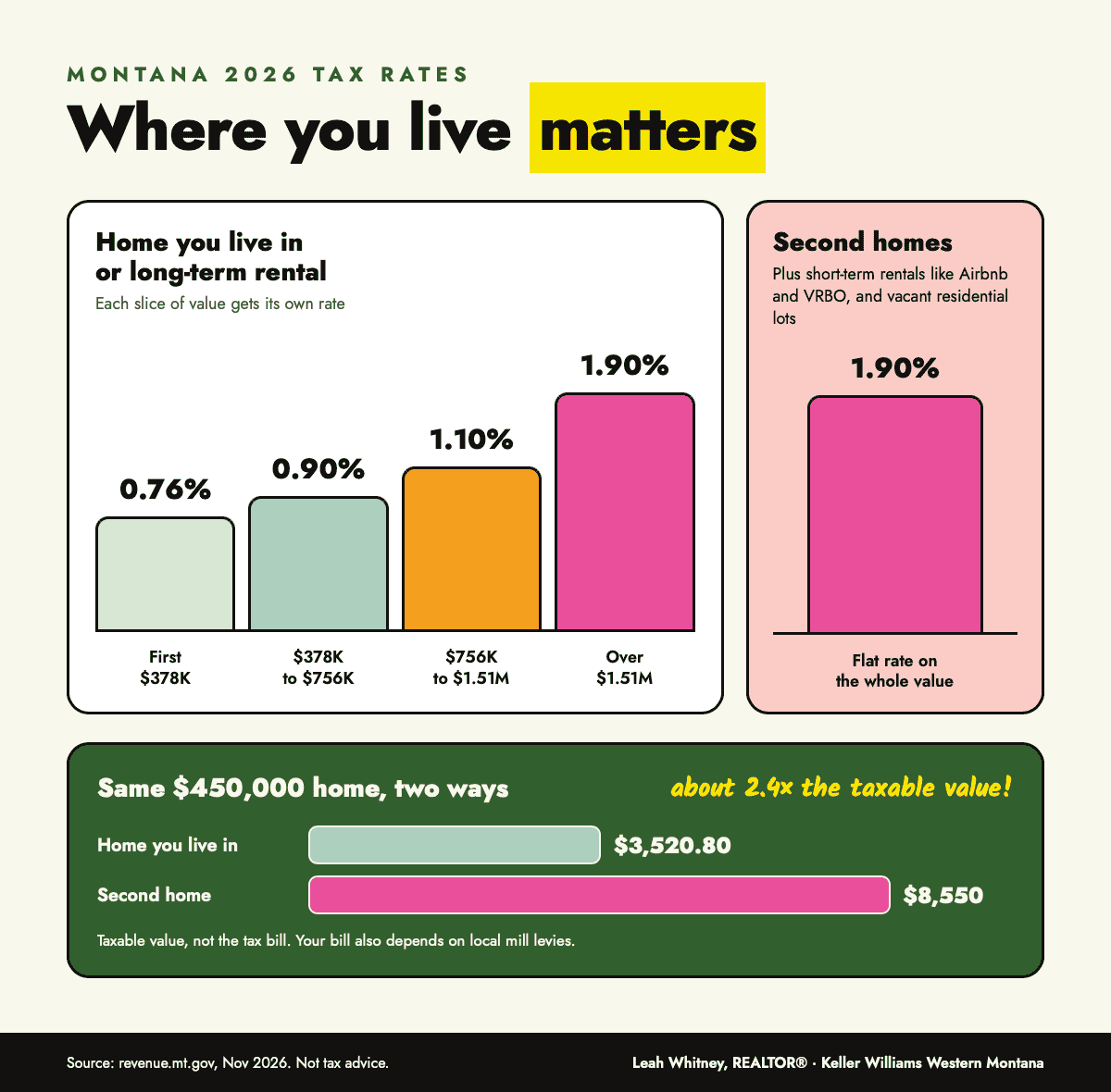
For primary homes and long-term rentals, the rate goes up in steps as the value goes up. Each slice of your home's value is taxed at its own rate, so a higher step only applies to the part of the value inside it.
| Portion of market value | 2026 rate |
|---|---|
| First $378,000 | 0.76% |
| $378,001 to $756,000 | 0.90% |
| $756,001 to $1,511,999 | 1.10% |
| Over $1,512,000 | 1.90% |
Source: Montana Department of Revenue.
Second homes, short-term rentals like Airbnbs and VRBOs, and vacant residential lots are taxed at a flat 1.90%. Apartment buildings and other multifamily long-term rentals are taxed at a flat 1.10%.
Here's how that plays out for a home with a market value of $450,000. The number you end up with is called taxable value (more on that in a second):
As a primary home: 0.76% of the first $378,000 is $2,872.80, plus 0.90% of the remaining $72,000 is $648. That's a taxable value of $3,520.80.
As a second home: 1.90% of $450,000 is a taxable value of $8,550.
Same house, about 2.4 times the taxable value. That's a big difference, which is why it's worth making sure your home is classified correctly.
What this looks like in Missoula and the Bitterroot
Missoula County's median home value was $507,000 in 2025, up 27% from the year before, according to the Department of Revenue. That means a typical Missoula home is past the first $378,000 and gets into the 0.90% step. At the median, that's a taxable value of $4,033.80 as a primary home and $9,633 as a second home.
In Ravalli County, the median was $453,000, up 21%. At the median, that's a taxable value of $3,547.80 as a primary home and $8,607 as a second home.
Your own home's value could be higher or lower, so check your assessment notice or the state's property records for your number.
Wait, what's "taxable value"?
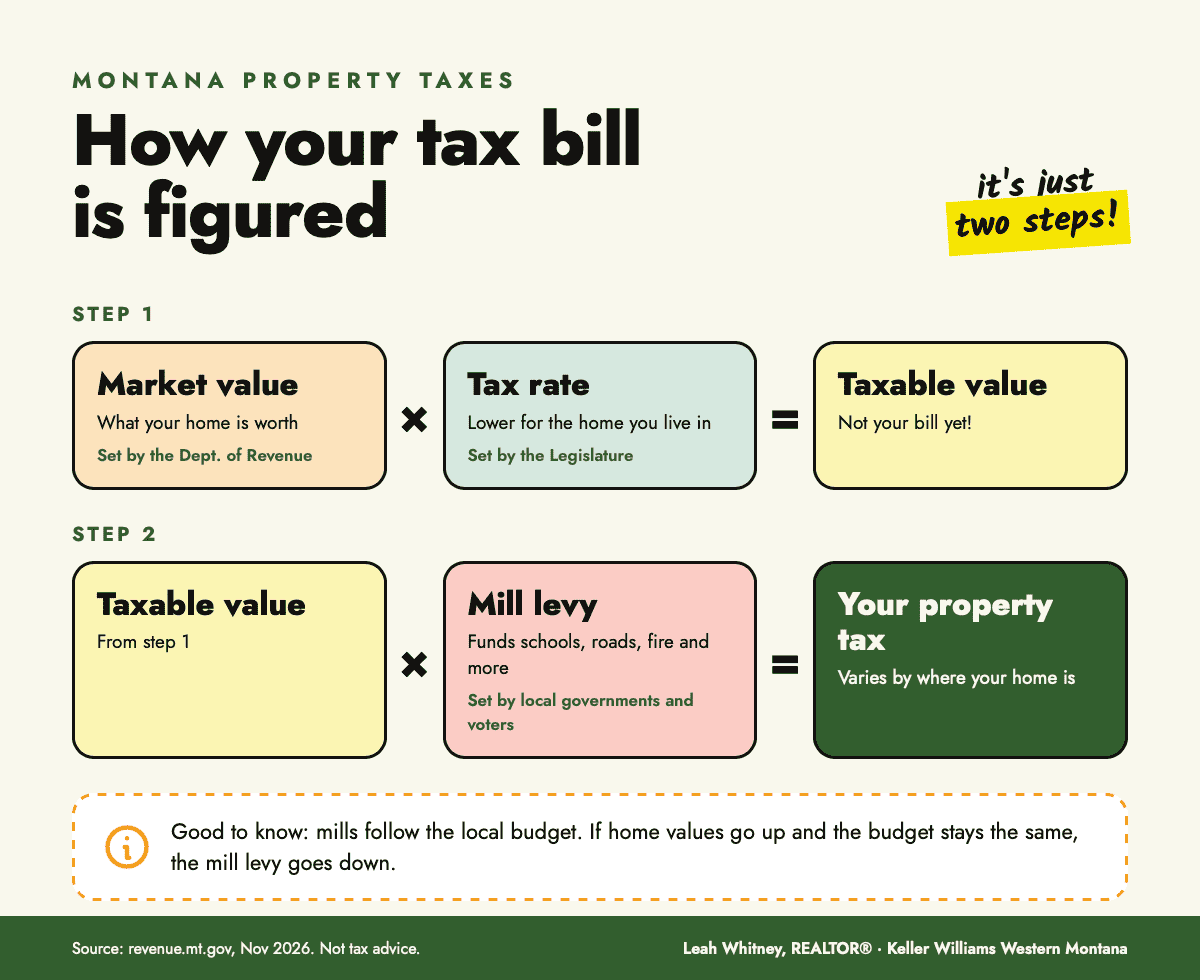
This is the part that trips most people up. Your tax bill is figured in two steps:
Market value × tax rate = taxable value
Taxable value × mill levy = your property tax
Three different groups set those numbers. The Department of Revenue sets your market value. The Legislature sets the tax rates (the percentages above). Local governments and voters set the mill levies, which fund local schools and services.
So the example above isn't a tax bill. Your actual bill depends on the mill levies where your home is, which vary from town to town.
One more thing that surprises people: when values go up, it doesn't automatically mean your local government collects more. Mills are based on the budget. If a town needs the same budget and total taxable value goes up, the mill levy goes down. Your bill changes when your share of the total changes, or when budgets change.
Who qualifies for Montana's 2026 homestead refund?
If you lived in your home in 2026 but it wasn't taxed at the lower rate, the state is offering a one-time refund of the difference. This could apply to you if you bought your home in 2025 or early 2026, or never received the 2025 rebate, and didn't apply for the lower rate by the March 20, 2026 deadline. Not sure? You can check your home's status at homestead.mt.gov.
Here's a real one. I had a first-time buyer close on a Missoula home in early April. At the time, we didn't know the state would offer this refund, so we were in a bit of limbo on what their taxes would look like. They called the county and the Department of Revenue and got different answers depending on who they talked to. Now the picture is clearer. They've lived in the home more than 7 months of 2026, so they should qualify for the refund. Once it's approved, they'll be on the lower rate automatically starting in 2027.
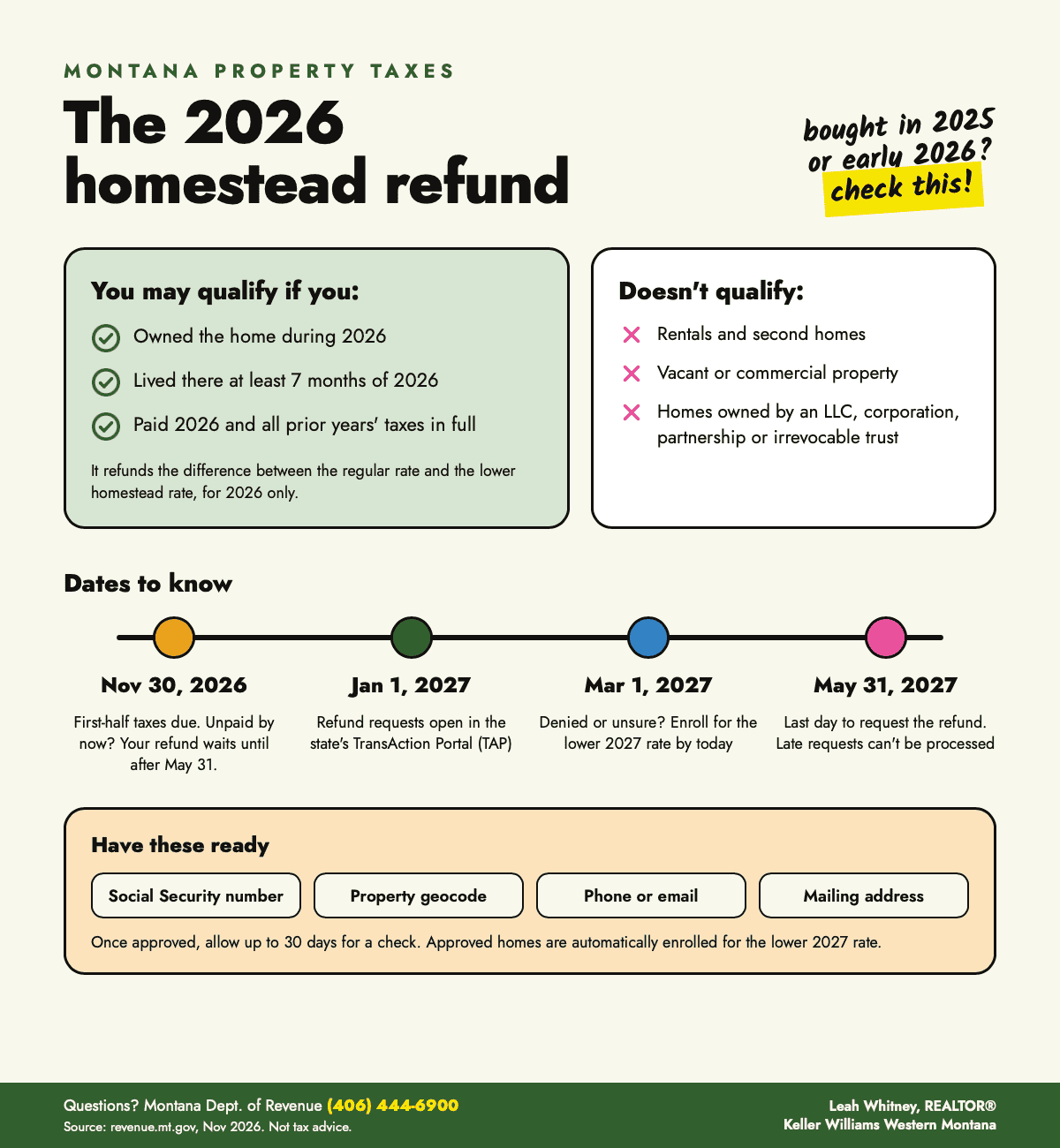
You may qualify if you:
Owned the home during 2026
Lived there as your primary residence at least 7 months of 2026
Paid your 2026 property taxes and all prior years' taxes in full
Rentals, second homes, vacant property and commercial property don't qualify. Neither do homes owned by an LLC, corporation, partnership or irrevocable trust.
How do I apply for the refund?
Requests open January 1, 2027, in the state's TransAction Portal (TAP).
The deadline is May 31, 2027. Late requests can't be processed.
You'll need your Social Security number, your property's geocode, a phone number or email, and a mailing address.
Once it's approved, allow up to 30 days for a check in the mail.
You can apply before your taxes are paid, but the state won't process it until the county confirms they're paid in full. And timing matters here: if your 2026 taxes aren't paid by the first-half due date of November 30, 2026, your refund won't be processed until after the second-half due date of May 31, 2027. Even if you pay on time, the state waits for the county to confirm payment, so plan on this taking a while.
The refund only covers 2026. It's the difference between the regular rate and the lower homestead rate, not a refund of all your taxes.
A nice bonus: if your refund is approved, your home is automatically enrolled for the lower rate in 2027. If it's denied, or you're not sure you qualify, you can still apply for the 2027 lower rate by March 1, 2027.
What does this mean if you're buying or selling in Missoula?
If you're buying a home you plan to live in, the lower rate isn't automatic just because you moved in. Once you close, enroll at homestead.mt.gov so you don't miss a year like some 2025 buyers did. The window for 2027 is open now through March 1, 2027.
If you're thinking about a cabin, a second home or a short-term rental, plan your budget around the 1.90% rate, not the lower one the current owner might be paying. The tax amount on a listing reflects how the seller uses the home, and it can change once you own it.
If you're selling a home you've lived in, the same idea works in reverse. Your tax amount reflects the lower homestead rate, and a buyer who plans to use it as a second home or rental should expect it to go up.
When I'm working with buyers, I'll flag this before you make an offer and point you to the county or the Department of Revenue for exact numbers, so there are no surprises later.
Where to get help
The Department of Revenue is the place for questions about your specific property. You can call them at (406) 444-6900 or email DORHelp@mt.gov. Their pages are linked below.
Questions about your actual tax bill? Your county treasurer's office is the place to call.
And if you have questions about how this affects a home you're thinking about buying or selling, reach out. I'm always happy to talk it through.
This post is for general information and isn't tax or legal advice. Rates and dates are from the Montana Department of Revenue as of November 2026 and may change. Talk to a tax professional or the Department of Revenue about your own property.
Leah Whitney is a Missoula-based REALTOR® known for data-driven strategy, creative marketing, and a calm, personal approach to real estate. She's a second-generation REALTOR® and volunteers as a homebuyer-education instructor with Homeword. From Nest Egg to Empty Nest, I've Got You. Keller Williams Western Montana.